วันจันทร์ที่ 26 พฤษภาคม พ.ศ. 2551

Probe lands on Mars, NASA says


(CNN) -- The first pictures from NASA's Mars Phoenix Lander, which successfully touched down near Mars' north pole Sunday, showed a pattern of brown polygons as far as the camera could see.

The Mars Phoenix Lander took this image of the planet's surface at its landing site Sunday.

1 2 3 4


var CNN_ArticleChanger = new CNN_imageChanger('cnnImgChngr','/2008/TECH/space/05/25/mars.lander/imgChng/p1-0.init.exclude.html',3,1);
//CNN.imageChanger.load('cnnImgChngr','imgChng/p1-0.exclude.html');
"It's surprisingly close to what we expected and that's what surprises me most," said Peter Smith, the mission's principal investigator. "I expected a bigger surprise."
The landing on the Red Planet's arctic plains -- which ended a 296-day journey -- was right on target, a feat NASA's Ed Weiler compared to landing a hole-in-one with a golf ball from 10,000 miles.
The landing -- dubbed the "seven minutes of terror" -- was a nerve-wracking experience for mission managers, who have witnessed the failure of similar missions.
In mission control at NASA's Jet Propulsion Laboratory in Pasadena, California, they celebrated the lander's much-anticipated entry.
"It was better than we could have imagined," Barry Goldstein, project manager for the Phoenix mission, told CNN. Watch the celebration at mission control »
The Phoenix's 90-day mission is to analyze the soils and permafrost of Mars' arctic tundra for signs of past or present life.
The lander is equipped with a robotic arm capable of scooping up ice and dirt to look for organic evidence that life once existed there, or even exists now.
Don't Miss
Space: The ultimate vacation
In Depth: Life in 2020
NASA: Phoenix mission page
SciTechBlog: Mood of the Phoenix team
"We are not going to be able to answer the final question of is there life on Mars," said principal investigator Peter Smith, an optical scientist with the University of Arizona. "We will take the next important step. We'll find out if there's organic material associated with this ice in the polar regions. Ice is a preserver, and if there ever were organics on Mars and they got into that ice, they will still be there today."
The twin to the Mars Polar Lander spacecraft, Phoenix was supposed to travel to Mars in 2001 as the Mars Surveyor spacecraft. They were originally part of the "better, faster, cheaper" program, formulated by then-NASA Administrator Dan Goldin to beef up planetary exploration on a lean budget.
But Polar malfunctioned during its descent into Mars' atmosphere in 1999 and crashed. An investigation concluded that as many as a dozen design flaws or malfunctions doomed the spacecraft.
The failure of that mission, as well as another spacecraft called the Mars Climate Orbiter the same year, led to NASA to put future missions on hold and rethink the "better, faster, cheaper" approach. Mars Surveyor went to the warehouse. Watch the challenges the mission faced »
But all was not lost. In 2003, Smith proposed a plan to re-engineer the Mars Surveyor and fly it on a mission to look for signatures of life in the ice and dirt of Mars far North. Mars Phoenix, literally and figuratively, rose from the ashes of Surveyor.
Engineers set to work, testing and retesting the onboard system to ferret out and fix all the flaws they could find. iReport.com: Send your photos, video of space
"We always have to be scared to death," Goldstein said. "The minute we lose fear is the minute that we stop looking for the next problem."
The team was concerned about the Phoenix landing system. NASA had not successfully landed a probe on Mars using landing legs and stabilizing thrusters since the Viking missions in the late 1970s. The other three successful Mars landings -- Pathfinder in 1997 and the Spirit and Opportunity rovers in 2004 -- used massive airbags that inflated around the landing craft just before landing to cushion the impact. Learn about NASA's past missions to Mars »
The Phoenix doesn't have airbags because the lander is too big and heavy for them to work properly.
Its landing site was targeted for the far northern plains of Mars, near the northern polar ice cap. Data from the Mars Odyssey spacecraft indicate large quantities of ice there, likely in the form of permafrost, either on the surface or just barely underground.
[Blocked Ads]
[Blocked Ads]
"Follow the water" has become the unifying theme of NASA's Mars exploration strategy.
In 2004, the rover Opportunity found evidence that a salty sea once lapped the shores of an area near Mars' equator called Meridiani Planum. Astrobiologists generally agree that it's best to look for life in wet places.

iPhone sold out online


SAN FRANCISCO, California (AP) -- Apple Inc. said Monday its online stores in the U.S. and UK are sold out of the iPhone, a sign supplies are being winnowed ahead of the launch of the device's next generation featuring faster Internet surfing speeds.

The iPhone is out of stock online, but brick-and-mortar stores run by Apple and AT&T might still have units.

The Cupertino-based company confirmed that the iPhone is out of stock online, but added that brick-and-mortar stores run by Apple and iPhone carriers including AT&T Inc. might still have units available.
Apple spokeswoman Natalie Kerris declined to comment on reasons for the shortage and on Apple's plans for an update to the device, which is widely expected to be unveiled in June at Apple's Worldwide Developers Conference in San Francisco.
The paucity of iPhones for sale in some markets comes as Apple is hustling to meet its goal of selling 10 million of the hybrid iPod-cell phone-Internet surfing gadgets by the end of 2008. So far, Apple has sold 5.4 million iPhones, according to the latest data as of the end of March. Watch how new iPhones will compete with a new BlackBerry model »
One way Apple is expanding the iPhone's reach is by inking deals with wireless carriers around the world, even breaking with its pattern of requiring exclusivity to sell in a certain country.
On Monday, four mobile providers in the Asia-Pacific region announced partnerships with Apple to bring the iPhone to their regions later this year.
SingTel will sell the gadget in Singapore, Bharti Airtel Ltd. in India, Globe Telecom Inc. in the Philippines and Optus in Australia, the companies said in a brief joint statement, without giving details.
Don't Miss
iReport.com: Send a photo with your iPhone
Unlocked iPhone coveted in Israel
SingTel owns Optus and holds a 30.5 percent stake in Bharti and 44.5 percent in Globe.
SingTel has about 2.3 million mobile subscribers in Singapore and around 7 million in Australia, according to data as of December 31, 2007. Bharti currently has about 64 million subscribers, while Globe reported a 21.3 million mobile subscriber base for the quarter ended March 31.
Last week, the top mobile phone operator in Latin America, America Movil SAB, also announced plans to deliver the iPhone to its region. America Movil has 159.2 million subscribers in 16 countries, including Argentina, Brazil, Chile, Colombia and Mexico.
In recent weeks Apple has also signed deals with Rogers Communications Inc. to sell the device in Canada; Milan-based Telecom Italia SpA to sell the iPhone in Italy; and Vodafone Group PLC, the world's biggest mobile company by sales, to sell it in a total of 10 countries, including Australia, India, Italy and Turkey.
Until the spate of the latest deals, Apple adhered to its policy of exclusivity with one carrier in each country.
The exclusive deals for the iPhone were with AT&T Inc. in the United States, O2 in Britain, T-Mobile in Germany and France Telecom's Orange wireless arm in France.
Industry observers say some people may be holding off on buying an iPhone until the much-rumored next-generation of the device is launched, and the phone is officially rolled out in more countries.
It takes some technical gymnastics, but it's still possible to get the phone in some markets where Apple doesn't have arrangements with wireless carriers.
[Blocked Ads]
[Blocked Ads]
Many of the phones sold so far have been bought legitimately in one country, modified to work on any cellular network, and resold in countries where Apple doesn't have agreements to sell the iPhone. The trend expands the iPhone's reach but deprives Apple of some of the subscriber fees that Apple splits with its carrier partners.
Apple is also planning a software update for this summer that makes the iPhone work better with corporate e-mail, a necessary upgrade to help the iPhone compete with Research in Motion Ltd.'s BlackBerry and Palm Inc.'s Treo smart phones.

HONG KONG, China (CNN)

By Cherise FongFor CNN
HONG KONG, China (CNN) -- Way back in 1888, Kodak popularized the hobby of snapshot photography with its famous slogan: "You press the button, we do the rest."

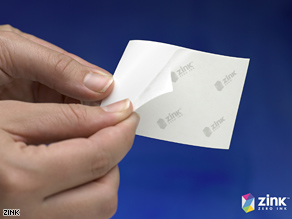
Zink paper is is dry, waterproof, smudge-proof, tear-proof, peel-off, sticky-backed -- and recyclable.
1 2 3
var CNN_ArticleChanger = new CNN_imageChanger('cnnImgChngr','/2008/TECH/05/22/digitalbiz.zink/imgChng/p1-0.init.exclude.html',2,1);
//CNN.imageChanger.load('cnnImgChngr','imgChng/p1-0.exclude.html');
Now, 120 years later, Zink says: "Just add paper" and do it yourself.
Zink is a zero-ink printing company that has updated the instant gratification that comes from developing pictures for the digital age.
The pleasure of snapping a picture and admiring the print hasn't changed, but the technology has, plus there is a new eco-friendly element.
Zink paper is an advanced composite material with embedded yellow, magenta and cyan dye crystals that change color when heated. For a 2"x3" print, a Zink-enabled printer uses 200 million heat pulses to activate and colorize 100 billion crystals, in 30 seconds, in a single pass.
The final result is a photographically correct print that is not only completely dry, but also waterproof, smudge-proof, tear-proof, peel-off and sticky-backed -- not to mention recyclable.
If Zink's thermal printing process sounds familiar, it differs from D2T2 (dye diffusion thermal transfer), or dye sublimation technology, used by other companies such as Kodak, Canon or Sony, in one crucial aspect -- Zink involves zero ink.
"The source of heat conveyed to the printer head is similar," says Steve Herchen, one of Zink's original inventors and present chief technology officer.
"The advantage with Zink is that there is no need for an ink ribbon. The heat is applied directly to the paper. There are no gears, no motors, no mechanism is required to manage the ink ribbon. All the information is in the paper."
Inkless footprint
So not only is Zink compact, it's ecological. Because there is no ink, there are no empty ink-ribbon cartridges and no extra packaging to dispose of.
"The paper is the print," concludes Herchen. "Printers can be the smallest footprint of any printing technology."
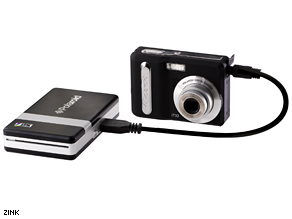
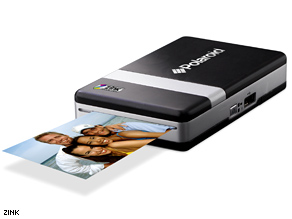
As the company's first consumer application to hit the market, the Zink-enabled Polaroid Instant Mobile Printer is only slightly bigger than an iPhone, weighs 230 grams, uses a rechargeable lithium-ion battery, and connects to a mobile phone via wireless Bluetooth or to a digital camera through a USB cable.
The pocket printer will be available later this summer in the United States, United Kingdom, France, Germany, Spain, Italy and Russia, and will sell for about $150, while Zink paper will be sold in packs of 10 or 30, at 33-40 cents per sheet.
With sales of camera phones and digital cameras growing exponentially, one can easily speculate about hundreds of billions of digital photos being snapped and "trapped" on memory cards and hard drives around the world.
But hold on a nanosec -- Why print to paper at all when we inhabit the global digisphere?
You know you want to
"Our research shows that in this digital age, more than ever, people still have a deep-rooted need to see, feel, mark, share or use their digital images or information in a physical form," remarks Scott Wicker, Zink's chief marketing officer.
"We know there's a pent-up need to print," confides Herchen, a 30-year Polaroid veteran. "Even though not everyone wants to print every image, there is still a real customer need to be able to print on-the-go, whenever you want, wirelessly, from portable devices."
So far, Zink has partnered with Polaroid and manufacturer Alps Electric to produce the Instant Mobile Printer, and with toy-maker TakaraTomy and manufacturer Foxconn for an upcoming product.
In addition, Zink has produced its own not-yet-released 6-megapixel digital camera-printer. If the combo-device doesn't appeal immediately to all die-hard digerati, it might be more likely to win over Polaroid Instamatic nostalgics, or anyone keen on wallet-sized snaps and Japanese-style "purikura" photo-sticker booths.
Commemorating those Kodak moments
Twenty-five-year-old student Caroline enjoys printing out those special shots for her scrapbook or making collages for friends, and she is happy to pick them up from the self-service kiosk after a short wait.
"I like to physically hold the prints and look at them in my hands," she says. "You appreciate a photo more when it's not on the computer. It's one that you've taken the trouble to print, maybe even frame, so you pay more attention."
If one person's print is that same person's carbon footprint, most people seem to agree that printing remains an inalienable delight.
Andy, of the Photo 2000 express kiosk in Hong Kong, confirms: "About half of the people out there prefer to view their pictures printed, rather than on a computer. But all people like to see real photos. All our customers print photos for friends and family, never for business... If they don't want to print, then we close."
Whether instant or not, at least now zero-ink provides us with an environment-friendly alternative to satisfy our pent-up printing desires.

FOUNTAIN HILLS, Arizona (CNN

FOUNTAIN HILLS, Arizona (CNN) -- A team of doctors from the Mayo Clinic declared Friday that there appears to be no physical reason why Sen. John McCain, the 71-year-old presumed Republican presidential candidate, could not carry out the duties of the office.

Sen. John McCain, who turns 72 in August, could become the oldest person elected to a first term as president.

1 of 2


var CNN_ArticleChanger = new CNN_imageChanger('cnnImgChngr','/2008/HEALTH/05/23/mccain.health.records/imgChng/p1-0.init.exclude.html',1,1);
//CNN.imageChanger.load('cnnImgChngr','imgChng/p1-0.exclude.html');
"Sen. McCain enjoys excellent health and displays extraordinary energy, and, while it is impossible to predict any person's future health, I and my colleagues can find no medical reason or problem that would preclude Sen. McCain from fulfilling all of the duties or obligations of the president of the United States," said Dr. John D. Eckstein, an internist who has been overseeing McCain's treatment for 16 years at the famed research center's campus in Scottsdale, Arizona.
McCain has been undergoing periodic examinations there since the 1990s and annual examinations since 2000, Eckstein said. His most recent comprehensive examination took place in March, with follow-up tests this month.
The doctors described a number of health issues faced by McCain, many of them typical for a man of his age but at least one of them potentially serious.
McCain has had four malignant melanomas removed. Three of them -- on his left shoulder, left arm and left nasal wall -- were limited to the top skin layer and were not invasive. They were removed in 1993, 2000 and 2002, and all were declared Stage 0, of little long-term concern.
But a fourth melanoma proved to be invasive and was removed from his left lower temple in 2000, Eckstein said.
The surgery on McCain's temple was carried out in August 2000 by Dr. Michael Hinni, who described the melanoma as 2.2 mm thick at the thickest point and 2 cm across.
Don't Miss
McCain to open medical records
Kennedy leaves hospital
McCain's health care proposal built on tax breaks
John McCain profile
Hinni said that, in order to leave a 2 cm margin that would minimize the risk of leaving some of the cancer intact, he had to remove a patch of skin roughly 6 cm in diameter, as well as an underlying carotid salivary gland from McCain's face.
Dissection of dozens of lymph nodes showed no evidence that the cancer had spread, he said.
According to the American Cancer Society, such a melanoma would be classified as Stage IIA, which is associated with a five-year survival rate of about 78 percent and a 10-year survival rate of about 66 percent.
The wound required major reconstruction and has left the senator with a mass of scar tissue on his face. His left jaw appears prominent because because there was an absence of soft tissue on the face in front of his ear, Hinni said.

Ryan Giggs could stay at Old Trafford beyond his playing days, according to Sir Alex Ferguson.

26/05/2008 07:09, Report by Gemma Thompson
Reds to retain Ryan for life?
Ryan Giggs could stay at Old Trafford beyond his playing days, according to Sir Alex Ferguson.The record-breaking winger claimed his second Champions League winners' medal on Wednesday night, ten days after scooping his tenth Premier League title.He's now the holder of United's all-time appearance record having surpassed Sir Bobby Charlton's tally in Moscow and Sir Alex believes the 34-year-old still has a few good years left in him yet."Ryan could play until his 38 and it would definitely be here. I think he'll be here for a long time," he said."He's taking his coaching badges and we like the structure of our former players remaining part of the club like Bryan Robson and Ole Gunnar Solskjaer, who are both ambassadors for the club."The model of that is, without question, Bayern Munich and I've been saying for years to the people at our club that our former players, who have been such a credit to United, should always be included in the future. I'm sure Ryan will be part of that."
CNN) -- It's been a long, long time since the last "last" time: When Dr. Henry "Indiana" Jones Jr. rode off into the sunset in May 1989, courtesy of "Indiana Jones and the Last Crusade," the Berlin Wall was still standing, George H.W. Bush was only four months into his presidency, and Harrison Ford was just a young whippersnapper of 46.

Harrison Ford returns as Indiana Jones in "Indiana Jones and the Kingdom of the Crystal Skull."

Quite why Ford, Steven Spielberg and George Lucas -- three of the wealthiest men in Hollywood -- should feel the need to resurrect Indiana Jones at this late stage of the game is anybody's guess. The three men have a combined age of 191, but like many boomers, they're not ready for the rest home just yet, even if living in the past seems a strange way to show it.
The first Indiana Jones film, "Raiders of the Lost Ark," was already a nostalgia trip when it was released in 1981, a guileless celebration of the old-fashioned Saturday morning adventure serials that were a staple for any kid growing up in the '30s, '40s and '50s. That makes the new film, "Indiana Jones and the Kingdom of the Crystal Skull," a throwback to a throwback.
But time is catching up with the series.
The new film is set in 1957, enabling Ford to act his age (or something like it). But this is the outer edge of a time when America could still believe in the simple black-and-white morality Indiana represents. If the Nazis and the Reds couldn't finish him off, the '60s surely would.
Still, in some ways, the extra years suit Ford. Indiana has always been a surly old sourpuss, a pragmatic, world-weary hero in the classic WWII mold. Indy's fondness for griping is part of what makes him human. And when it comes to trading punches, cracking heads or disinterring the dead, Ford can still get it done. If he can't, his stunt double can. Watch what some other critics are saying »
The movie opens in Nevada, where Dr. Jones is caught up in a daring raid on Area 51 led by Soviet agent Irina Spalko, played by a Cate Blanchett in a severe black bob, long black rubber gloves and a rapier. (It's a get-up so outré, even Joe Stalin would smile.) In a twist worthy of "The Twilight Zone," Indy finds himself in an ersatz small town populated by cardboard figures watching "Howdy Doody" -- a test site for an imminent A-bomb explosion.
Don't Miss
iReport.com: What did you think of 'Indiana Jones'? Let us know
Indy 'immune' from critics' voices
Indy comes to Harlem
This bravura, breakneck opening immediately rekindles the old magic: the mixture of bravado and wit with action sequences that keep piling on layer upon layer of peril. Unfortunately, this is also the high point of the movie, or close to it.
Indiana's brush with the Reds makes him a person of interest to the FBI just after the height of the McCarthy period, a quick, passing nod toward a post-9/11 sensibility that the movie runs away from almost as desperately as Indy scrambles from an army of man-eating ants. At this point, screenwriter David Koepp in effect starts the story all over again, this time with Brylcreemed biker Mutt Williams (Shia LaBeouf) making a clumsy pitch about rescuing his mom from kidnappers in South America.
That, and something about a legendary crystal skull, get Indiana Jones' juices churning, and suddenly the old professor and the young tough are off on an adventure.
This outlandish hokum doesn't bear close scrutiny, so it's probably just as well Dr. Jones is not one for introspection. He does his thinking on his feet, and so does Spielberg, who sometimes seems to be directing this with one eye on the exit signs.
It is good to see Karen Allen back as Marion Ravenwood, easily the pick of Indiana's women. She lends the enterprise some heart that is sorely lacking elsewhere. It's just a pity Koepp can't find more for her to do. (Ray Winstone, as an Indy colleague, is also poorly used.)
A long jungle chase is another bona fide highlight, but Spielberg and Lucas misjudge the film's extravagant CGI climax; I won't spoil it here, but it feels alien to Indy's world. Let's just say we have seen this before, from Spielberg himself, and done better, too.
[Blocked Ads]
[Blocked Ads]
"Indiana Jones and the Kingdom of the Crystal Skull" has enough going for it to secure the bronze medal in the series and even compete for the silver, but "The Last Crusade" was a more graceful farewell. Indeed, the prospect of a revived series -- either with Ford or LaBeouf in the driver's seat -- isn't especially enticing. "The Adventures of Mutt Williams," anyone?

วันเสาร์ที่ 24 พฤษภาคม พ.ศ. 2551

Kings of Europe!

United are champions of Europe for the third time after a dramatic penalty shoot-out victory over Chelsea at the Luzhniki Stadium.Forty years after first winning the European Cup at Wembley in 1968, and 50 years since the Munich tragedy, fate played a big part as a dramatic final in Moscow went to penalties.
After Cristiano Ronaldo had missed his kick for United, John Terry had the chance to win the cup for Chelsea, but the Blues skipper slipped on the run up and his penalty hit the post. After Anderson and Giggs, plus Kalou for Chelsea, then converted, Nicolas Anelka's sudden death shot was finally saved by Edwin van der Sar, sparking jubilant scenes among United’s rain-soaked travelling contingent.Cristiano Ronaldo had given United a 26th minute lead with a header from Wes Brown’s cross in a first half which the Reds dominated. Carlos Tevez had two clear chances to put United 2-0 ahead, but his efforts were well saved by Chelsea keeper Petr Cech, who also denied Michael Carrick.Chelsea gained a foothold in the game in the final few minutes of the first half, and equalised with almost the last kick of the half, when a deflected